
Satiety & Balance Support
Support steadier nourishment rhythm and meal satisfaction.
This pathway belongs first to Metabolic Balance and can also connect with Digestive Comfort when additional context is useful.
Focus Areas Connected


RELATED FOCUS AREA
Digestive Comfort
Adds useful context when the support need crosses domains.
How We Support (Methods / Pathways)
Slower first minutesGive meals a calmer start.
Use the first few minutes of a meal to slow the transition into eating: sit down where possible, put the next task aside, and begin without rushing. There is no need to force an unusually slow pace; the aim is simply to make the meal easier to notice and less dominated by the previous activity. Keep “Slower first minutes” proportionate to the rest of the Satiety & Balance Support routine and simplify it if it becomes hard to repeat.
Satisfaction checkNotice fullness, energy, and enjoyment without judgement.
Use a short, neutral check-in to notice what is present before deciding what the day should look like. Consider energy, hunger, tension, workload, or available time, then make one proportionate adjustment rather than judging the whole routine. For Satiety & Balance Support, the useful version of “Satisfaction check” is the one that still works on an ordinary busy day.
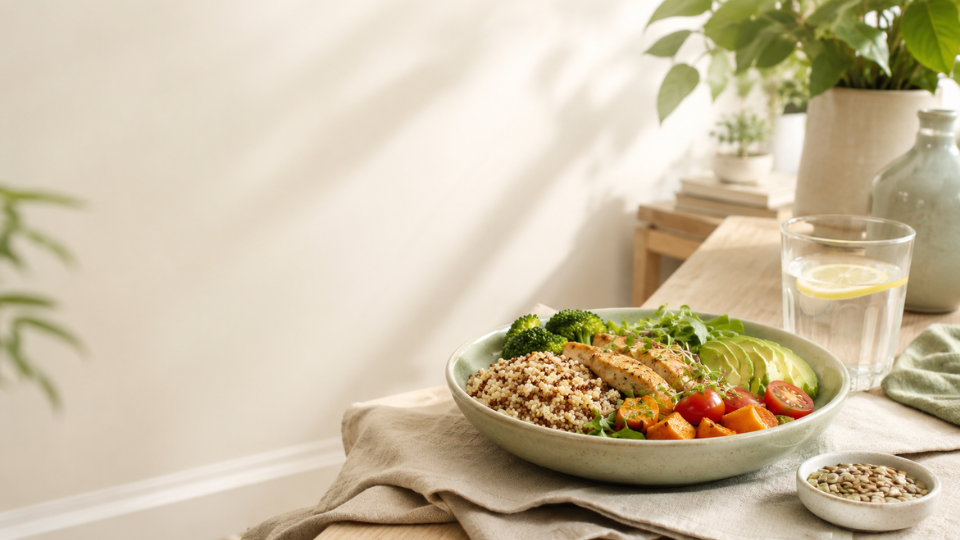
Meal composition cueBuild meals that feel complete and sustainable.
Build the meal around enough food to feel satisfying, with a mix of familiar components rather than a restrictive formula. The cue is to make meals feel complete and repeatable so the wider daily rhythm is easier to maintain. Use “Meal composition cue” as a practical part of Satiety & Balance Support, not as another obligation that has to be completed perfectly.
Planned support snackUse snacks as part of the rhythm, not as an afterthought.
If a snack is useful in your day, decide roughly when and why it helps before hunger or workload makes the choice reactive. Keep an easy option available for predictable long gaps, travel, or late meetings, and let it support the wider meal rhythm rather than replace meals by default. Use “Planned support snack” as one flexible support cue within Satiety & Balance Support, rather than a stand-alone rule that has to be followed exactly.
Routine over restrictionFocus on repeatable structure rather than control.
Use regular opportunities to eat and a workable meal structure as the foundation rather than relying on increasingly strict rules. If a routine only works when every day is tightly controlled, simplify it until it can survive ordinary changes in schedule. Use “Routine over restriction” as one flexible support cue within Satiety & Balance Support, rather than a stand-alone rule that has to be followed exactly.
Related Ways to Support
Metabolic Rhythm Support
A connected support pathway for additional daily context.
Nutritional Rhythm Support
A connected support pathway for additional daily context.
Explore Related Topics
Nourishment Rhythm & Daily Balance
Explore the topic neighbourhood connected to this support pathway.
Featured Guides & Articles
Related Objectives
Metabolic Balance
Explore support for “Balanced Nutrition & Metabolic Rhythm” through the most relevant focus areas and daily pathways.
Questions About Satiety & Balance Support
What does Satiety & Balance Support support?
Satiety & Balance Support supports a clearer daily structure around metabolic balance and related wellness routines.
Is this a fixed routine?
No. This page is an educational support pathway. It helps organise ideas and internal links, but it does not give a rigid plan or personal instruction.
Where should I go next?
Start with the connected focus area, then open the related topic or featured reading that best matches what you want to understand next.
Disclaimer: This content is educational wellness information and does not diagnose, treat, cure, or prevent any disease or condition. It is not a substitute for personalised medical advice.
Continue Exploring
Choose the focus area, topic, or objective that best matches your current priority, and continue through the governed GALMS knowledge structure.