
Evening Routines and Restorative Sleep
A practical, evidence-informed guide to building a flexible evening routine around timing, light, stimulation, preparation and repeatable cues.
Introduction
An evening routine is most useful when it makes the final part of the day simpler rather than more demanding. Instead of trying to force sleep, it creates a familiar transition: daytime responsibilities begin to close, light and stimulation become gentler, practical preparation happens before exhaustion, and one or two quiet cues are repeated. Research on sleep timing, evening light and caffeine supports several parts of this approach, while other elements—such as writing down unfinished tasks—are practical ways to reduce friction rather than physiological claims. The goal is a flexible routine that supports daily rhythm and leaves enough room for real life.
- Part of this topic: Evening Rhythm & Restorative Sleep
- Related focus area: Sleep & Restoration
- Related way to support: Circadian Support
Key Takeaways
- An evening routine is a repeatable transition, not a test of whether you can make sleep happen on command.
- A broadly consistent schedule and enough sleep opportunity matter more than adding a long list of bedtime rituals.
- Lower evening light and reduced unnecessary stimulation are practical cues because light exposure can shift circadian timing.
- Substantial caffeine can affect sleep even when used several hours before bed, although individual sensitivity varies.
- A short backup routine is often more sustainable than an ideal routine that only works on perfect evenings.
What this topic means
An evening routine is a sequence of actions that marks the shift from active daytime demands toward the period set aside for rest. It cannot control exactly when sleep begins or guarantee how refreshed someone will feel the next morning. The routine is best understood as a support structure: it organizes timing, environment and everyday behavior so the evening has a recognizable direction.
That structure can be very small. One person may close the laptop, dim the living-room lights, prepare clothes for morning and read for ten minutes. Another may finish family tasks, put tomorrow’s essentials by the door and listen to quiet audio. The specific activities can differ; the useful feature is that the sequence is familiar and repeatable.
Sleep itself is regulated across the whole day. Official NIH education describes an interaction between circadian timing and sleep pressure, with light and darkness acting as major timing cues. [2] That is why a bedtime routine works best as part of a broader daily rhythm rather than as an isolated ritual performed at the last minute.
Why it matters in daily life
Modern evenings can continue the daytime message long after work technically ends. Bright rooms, work communication, stimulating media, household decisions and late caffeine can all keep the period before bed highly active. A routine creates a boundary around those inputs and reduces the need to decide from scratch what happens next.
Evening light is one area with direct human evidence. In a controlled e-reader study, prolonged evening use of a light-emitting device shifted circadian timing and was linked with lower next-morning alertness compared with printed reading. [3] A separate laboratory study found that ordinary room light before bedtime delayed the onset of melatonin compared with very dim light in young adults. [4] These findings do not mean every screen or lamp is harmful; they support the simpler idea that light level and timing matter.
Caffeine is another practical variable. A controlled study using a substantial 400 mg dose found measurable sleep disruption even when caffeine was taken six hours before bedtime. [5] Because dose and sensitivity vary, this does not establish a universal six-hour cutoff. A more useful approach is to notice whether later caffeine repeatedly makes the evening transition or sleep timing feel less settled.
Another reason evening structure matters is that sleep opportunity can be reduced gradually rather than by one obvious decision. Ten minutes of work, another household task, or an open-ended piece of entertainment can each seem small, yet together they can keep moving the point at which the day actually ends. A routine makes that boundary visible. It does not need to create sleepiness; its practical value is that it protects a period in which the strongest daytime demands are no longer being extended by default.
When it matters
Evening structure can be especially useful when the day has no natural stopping point: remote work, caregiving, late study, travel, shared households or periods of heavy administration. In these situations, the routine provides a transition that the schedule may not provide automatically.
It also matters when bedtime regularly drifts because of small open-ended activities—one more email, one more episode, one more task. The routine moves those decisions earlier. Rather than deciding at the moment of exhaustion whether the day is finished, a person can use a chosen closing cue and then move through a smaller set of predictable steps.
Irregular evenings do not require perfection. A late social event or demanding day does not erase the value of a routine. The more useful question is whether there is a minimum version that can still be used: close essential tasks, reduce the strongest source of stimulation, prepare the room and use one familiar cue.
How to support it
Start by choosing two anchors rather than seven new habits. The first is a closing cue: for example, putting work materials away or writing tomorrow’s first task. Its purpose is practical: to keep unfinished responsibilities from expanding indefinitely into the evening.
Next, make the environment gradually less activating. Use comfortable lower lighting when practical, reduce non-essential notifications, and choose calmer content near bedtime. The evidence supports attention to evening light exposure; it does not require a rigid digital detox. If screens are necessary, brightness, viewing distance, duration and the type of activity are all reasonable factors to consider.
Protect adequate sleep opportunity and keep bed and wake timing broadly consistent when life allows. NHLBI guidance emphasizes similar bed and wake times, including weekends, while systematic-review evidence supports regularity as one part of sleep health. [1][6] The aim is a stable range, not minute-by-minute perfection.
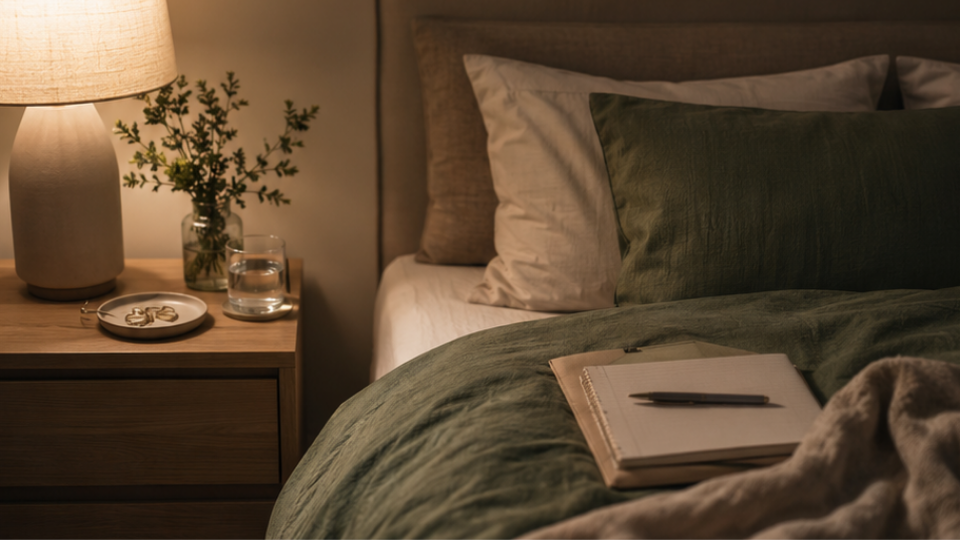
Finally, prepare the bedroom before the last moment. A quiet, cool and dark room is consistent with official sleep-habit guidance. [1] Put practical tasks—alarm, clothing, curtains, essential items—earlier in the routine so the final minutes do not become a new burst of activity.
Keep the sequence recognizable even when the clock changes. For example, the same order might be: close work, lower the brightest light, prepare one or two essentials for morning, complete hygiene, then use a quiet settling activity. Repeating the order is often more realistic than insisting that every step happen at exactly the same time. This also makes it easier to identify which part of the routine is useful and which part has become unnecessary complexity.
Practical routine considerations
Build three versions of the same routine. A minimum version might take ten to fifteen minutes; a standard version might take longer; a spacious version can include more preparation or leisure. Keep the order similar even when the duration changes. This protects continuity without making the longest version the only version that counts.
If caffeine is part of the day, consider the amount and timing rather than assuming one cutoff suits everyone. If evening screens are necessary, reduce unnecessary brightness and use them for lower-demand tasks when possible. If a household is noisy or shared, focus on the cues you can control rather than trying to create an unrealistic ideal environment.
A simple sleep diary can help identify patterns without turning sleep into a score. [1] Record approximate routine start, bedtime, wake time and obvious variables such as late caffeine or unusually bright/active evenings for a short period. Change one element at a time and judge whether the routine became easier to maintain.
Design the routine around the household you actually have. If evenings include children, shared living space, late work or caregiving, choose cues that can survive those conditions. A closing cue can happen before the house is quiet; softer lighting can begin in only one room; a settling activity can be brief. When the evening runs late, keep the final two or three steps and shorten the rest rather than abandoning the structure completely. This preserves continuity without turning routine consistency into another demand.
Common mistakes / what to avoid
Avoid making the routine so ambitious that it only works on quiet evenings. Avoid treating every screen exposure as equivalent; prolonged bright, stimulating use is not the same as a brief practical task. Avoid relying on caffeine timing rules without considering dose and personal sensitivity. And avoid judging the routine by one night.
Keep the routine simple and product-neutral. It does not require a purchased solution, supplement stack or complicated checklist. Timing, light, environment, consistency and practical closure are enough to build a useful evening structure.
If sleep difficulties are persistent, severe, affect safety or substantially interfere with daily functioning, general wellness guidance may not be enough. Consider seeking qualified professional advice rather than trying to work out the cause alone.
Frequently Asked Questions
How long should an evening routine be?
There is no universal length. A short routine can be useful if it reliably closes the active day, reduces unnecessary stimulation and prepares the sleep environment. The best length is the one that fits the household and can be repeated without becoming another source of pressure.
Do I need to stop using every screen before bed?
No. Human studies show that prolonged evening exposure to light-emitting devices can affect circadian timing, but screen use differs in brightness, duration and content. A practical goal is to reduce unnecessary bright or stimulating use and create a clear boundary around work and high-input content.
What if my evenings are unpredictable?
Use a minimum version with only a few cues: close the most important open loop, lower one source of stimulation, prepare the room and repeat one familiar settling activity. Return to the fuller version when the evening allows it.
Does a late night mean the routine failed?
No. Regularity is a pattern across time, not a single perfect night. Resume the usual anchors at the next reasonable opportunity rather than trying to compensate with an extreme schedule change.
Sources7 references
- Healthy Sleep Habits — National Heart, Lung, and Blood Institute (NIH) (2022). General guidance rather than a controlled trial; recommendations are broad and not individualized.
- Your Sleep/Wake Cycle — National Heart, Lung, and Blood Institute (NIH) (2022). Educational overview; it does not establish one routine or timing rule for every person.
- Chang AM et al. Evening use of light-emitting eReaders negatively affects sleep, circadian timing, and next-morning alertness (2015). Controlled exposure over several hours; results should not be generalized to every type, brightness, duration, or content of screen use.
- Gooley JJ et al. Exposure to room light before bedtime suppresses melatonin onset and shortens melatonin duration in humans (2011). Young healthy sample and controlled laboratory conditions; melatonin timing is a biological marker, not a guarantee of how an individual will sleep.
- Drake C et al. Caffeine effects on sleep taken 0, 3, or 6 hours before going to bed (2013). 400 mg is a substantial fixed dose; caffeine content, metabolism, sensitivity, and usual intake vary widely.
- Chaput JP et al. Sleep timing, sleep consistency, and health in adults: a systematic review (2020). Mostly observational evidence; associations do not prove causation, and the review could not establish universal thresholds.
- AASM/SRS Joint Consensus Statement: Recommended Amount of Sleep for a Healthy Adult (2015). Population-level consensus; individual sleep needs and context can vary.
Continue through GALMS
Related Reading

Disclaimer: This content is educational wellness information and does not diagnose, treat, cure, or prevent any disease or condition. It is not a substitute for personalised medical advice. Individual needs vary; seek qualified professional guidance when sleep difficulties are persistent, severe, affect safety or substantially interfere with daily life.
Continue Exploring
Return to the topic collection or continue through the connected support pathway.