
Evening Recovery Habits for Better Balance
Small, evidence-informed evening habits that help a demanding day lose intensity and create a steadier transition toward nighttime.
Introduction
Evening recovery does not have to mean a special protocol or a long list of self-care tasks. In this guide, recovery means giving a demanding day a clear chance to lose intensity: fewer open loops, a softer environment, lower-input activities and practical preparation before the final minutes of the night. Human research supports paying attention to evening light and caffeine, while small studies also suggest that simple writing and moderate evening movement can be used more flexibly than rigid sleep rules imply. The aim is a handful of habits that feel restorative because they reduce friction, not because they promise a particular physiological result.
- Part of this topic: Evening Recovery & Nighttime Balance
- Related focus area: Sleep & Restoration
- Related way to support: Evening Wind-Down
Key Takeaways
- Evening recovery habits should reduce demand rather than add another performance target.
- Light is a meaningful evening cue, but individual sensitivity to household light varies widely.
- Caffeine is dose- and timing-dependent, so personal patterns matter more than a universal rule.
- Simple task closure or short written planning can help move unfinished responsibilities out of the final part of the evening.
- Gentle or moderate evening movement is not automatically incompatible with sleep; context and individual response matter.
What this topic means
“Evening recovery habits” are small behaviors that help the day change mode. They are ordinary wellness actions that reduce the amount of work, light, noise, decision-making and unfinished preparation carried into the final part of the evening.
The word recovery is useful here because a full day often leaves several kinds of load at once: practical tasks, digital input, social obligations and a home environment that still looks and feels active. A recovery habit removes or simplifies one of those demands. Closing the work surface removes a visual cue. Writing tomorrow’s first task removes the need to keep rehearsing it. Lowering one bright light changes the environment. Preparing the bedroom prevents another rush of activity later.
NHLBI public-health guidance supports several elements of this general approach, including a quiet period before bed, less bright artificial light, attention to caffeine and a quiet, cool and dark bedroom. [3] The GALMS framing adds one design principle: choose habits that are small enough to use even after an imperfect day.
Why it matters in daily life
The evening home environment can influence circadian signals. In a large young-adult laboratory sample, ordinary room light before bedtime delayed melatonin onset compared with dim light. [4] Naturalistic home research also found that evening light exposure varied substantially between homes and individuals, and that greater evening light relative to a person’s usual exposure was associated with more wakefulness after bedtime. [5] The important message is not that one lamp is “bad.” It is that the evening can be made visually and behaviorally different from the active day.
Recovery habits also matter because a day can remain cognitively open even after formal work ends. A small randomized laboratory study found that healthy young adults who wrote a specific five-minute to-do list before bed fell asleep faster than those who wrote about completed activities. [7] This is limited evidence, but it supports a low-risk routine idea: if your mind is rehearsing tomorrow, capture the next steps rather than continuing to solve them.
At EU level, EFSA notes that a single 100 mg dose of caffeine may affect sleep duration and patterns in some adults, particularly when consumed close to bedtime. [1] Caffeine adds another layer. Newer randomized crossover evidence shows that the effect can depend strongly on dose and timing; in one small study, 400 mg affected several sleep measures when taken within twelve hours of bedtime, while 100 mg did not show significant effects under the tested conditions. [6] A recovery-oriented evening therefore begins partly with decisions made earlier in the day.
When it matters
These habits can be especially useful after days that feel densely packed: long meetings, commuting, family logistics, study, travel, social events, or sustained screen-based work. The goal is not to erase the day. It is to create a visible transition so that the same level of input does not continue until bedtime by default.
This guide addresses everyday wellness routines rather than treatment of insomnia. The 2023 European Insomnia Guideline recommends cognitive-behavioural therapy for insomnia (CBT-I) as first-line treatment for chronic insomnia in adults; persistent sleep difficulties that materially affect daytime functioning should be discussed with a qualified health professional. [2]
They also matter when “rest” becomes another form of stimulation. Fast scrolling, background television, late shopping, work chat or constant switching between apps may feel like stopping work while still keeping attention highly engaged. A recovery habit asks a simpler question: what can become quieter, dimmer, slower or already prepared?
On calmer evenings, the same habits can be used more lightly. The framework is not only for difficult days. Repeating a small transition on ordinary nights makes it easier to use when the day has been full, because the actions are already familiar.
How to support it
Use a small menu rather than a fixed script. Start with one habit from each of three categories: close, shift, settle. Close means ending or capturing unfinished responsibilities. A short written list can be useful for this purpose; the Scullin study supports it as an optional strategy in healthy young adults, not as a guaranteed result. [7]
Shift means change the environment. Lower the brightest household light when practical, reduce background noise, and move high-input media earlier. Research on home light shows wide differences in individual sensitivity, which argues for flexibility rather than a single “correct” evening lighting level. [5] Controlled display research likewise shows that the melanopic characteristics of screen light can change its biological effects. [8] The practical target is therefore lower unnecessary light and stimulation, not a total ban on technology.
Settle means choose one low-demand activity you genuinely like: reading, quiet conversation, warm showering, easy preparation, calm music or gentle mobility. It should not become an obligation. If it starts to feel like another task to complete, simplify it.
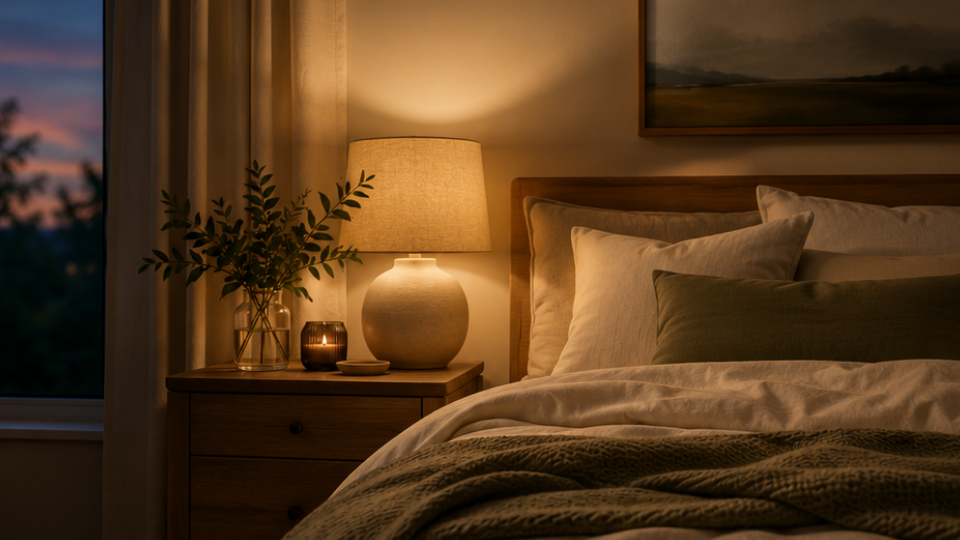
Prepare the sleep environment before you are exhausted. NHLBI public-health guidance recommends a bedroom that is quiet, cool and dark. [3] Put practical setup—curtains, alarm, clothing, essential items—earlier in the transition so the final minutes can stay lower input.
Practical routine considerations
A useful evening recovery pattern might take twenty to thirty minutes, but the exact duration is not important. Begin with a transition point, then choose two or three habits. For example: close work and write tomorrow’s first task; dim the main living-room light; prepare the bedroom; then read or listen to something quiet. On a late evening, use only the first and last steps.
Movement can be treated with similar flexibility. A small randomized crossover study in healthy young adults found that moderate running ending two or four hours before habitual bedtime did not disrupt sleep. [9] This does not apply to every intensity, person or schedule, but it argues against making all evening activity a forbidden category. A gentle walk or mobility routine may fit some evenings better than sitting with more digital input.
If caffeine seems relevant, look at patterns over several days rather than one night. Consider dose as well as timing. [6] If household light seems relevant, change the brightest source first and observe whether the evening feels easier to downshift. The purpose of self-observation is to simplify the routine, not to turn it into a measurement project.
Common mistakes / what to avoid
Avoid turning “recovery” into optimization. More products, more metrics and more steps can keep the evening focused on performance rather than closure. The most useful recovery habit may be subtractive: stop one stream of work, dim one light, prepare one item or end one source of input.
Avoid assuming that a habit is helpful because it is traditionally described as relaxing. People differ. A long bath, meditation app, stretching session or journal can be pleasant for one person and burdensome for another. Keep the parts that genuinely lower demand.
Avoid absolute rules about screens, exercise or caffeine. The evidence is more nuanced: screen-light effects depend on light characteristics and exposure, moderate evening exercise was not disruptive in one small healthy sample, and caffeine effects vary by dose and timing. [8] [9] [6] Use these findings to remove unnecessary rigidity, not to make new guarantees.
If sleep difficulties are persistent, severe, affect safety or substantially interfere with daily functioning, general wellness habits are not a substitute for professional assessment.
Frequently Asked Questions
What counts as an evening recovery habit?
Any small, repeatable action that lowers demand or prepares the transition into night can count: closing work, writing tomorrow’s first task, lowering bright light, preparing the bedroom, quiet reading or a gentle movement cue.
Is scrolling a good way to recover after work?
It can feel like a break, but high-input or bright screen use may keep the evening visually and mentally active. You do not need to remove every screen; consider whether the content, brightness and duration are actually helping the evening become lower demand.
Does evening exercise always interfere with sleep?
No. A small randomized study in healthy young adults found that moderate exercise ending two or four hours before habitual bedtime did not disrupt sleep. Intensity, timing and individual response still matter, so this should not be treated as a universal rule.
How many recovery habits should I use?
Start with two or three. If the routine only works when you complete a long list, it is probably too complex. Keep one minimum version for late or demanding evenings.
Sources9 references
- EFSA Panel on Dietetic Products, Nutrition and Allergies (NDA). Scientific Opinion on the safety of caffeine (2015). EU-level risk assessment requested by the European Commission; used for caffeine timing/sleep context, not as an individualized sleep prescription.
- Riemann D et al. The European Insomnia Guideline: An update on the diagnosis and treatment of insomnia 2023 (2023). European clinical guideline; used only to distinguish general wellness support from treatment of chronic insomnia.
- National Heart, Lung, and Blood Institute (NIH). Healthy Sleep Habits (2022). General guidance, not an individualized prescription or controlled trial.
- Gooley JJ et al.. Exposure to room light before bedtime suppresses melatonin onset and shortens melatonin duration in humans (2011). Young healthy sample; melatonin timing is a biological marker and does not guarantee how an individual will sleep.
- Cain SW et al.. Evening home lighting adversely impacts the circadian system and sleep (2020). Naturalistic/associational elements and substantial individual variability; do not present one lighting level as correct for everyone.
- Gardiner CL et al.. Dose and timing effects of caffeine on subsequent sleep: a randomized clinical crossover trial (2025). Small male sample; tested only 100 mg and 400 mg at specific time points, so results should not be generalized to every dose, person or schedule.
- Scullin MK et al.. The effects of bedtime writing on difficulty falling asleep: A polysomnographic study comparing to-do lists and completed activity lists (2018). Small healthy young-adult laboratory sample; this is an optional strategy, not a treatment or guaranteed effect.
- Schöllhorn I et al.. Melanopic irradiance defines the impact of evening display light on sleep latency, melatonin and alertness (2023). Healthy male sample and controlled exposure; does not justify a universal device setting or guarantee an effect for every user.
- Saidi O et al.. Effects of timing of moderate exercise in the evening on sleep and subsequent dietary intake in lean, young, healthy adults: randomized crossover study (2020). Very small, young, lean healthy sample; findings do not cover vigorous exercise very close to bedtime or all populations.
Continue through GALMS
Related Reading

Disclaimer: This content is educational wellness information and does not diagnose, treat, cure, or prevent any disease or condition. It is not a substitute for personalised medical advice. Individual needs vary; seek qualified professional guidance when sleep difficulties are persistent, severe, affect safety or substantially interfere with daily life.
Continue Exploring
Return to the topic collection or continue through the connected support pathway.